
The AI Sprint
Two weeks to see AI working in your business, before you commit to anything bigger.
Most leaders know AI could help. The question is where to start, and how to avoid spending six months and a lot of money finding out you picked the wrong thing.
The problem with most AI advice
Most consultants start with the technology. "Here are ten things AI could take off your plate." That sounds useful, and it skips the question that matters: are those workflows worth changing, and will anyone still be using it in three months?
AI amplifies whatever you point it at. Point it at a well understood workflow owned by someone who wants it, and it compounds. Point it at a process that exists because it has always existed, and you have made the mess faster.
There is a second problem. Most engagements end with a document. You get a deck, a ranked list, and a recommendation, and then you are on your own for the part that is genuinely hard.
The Sprint ends with something running.
What you get
- An Alignment Map
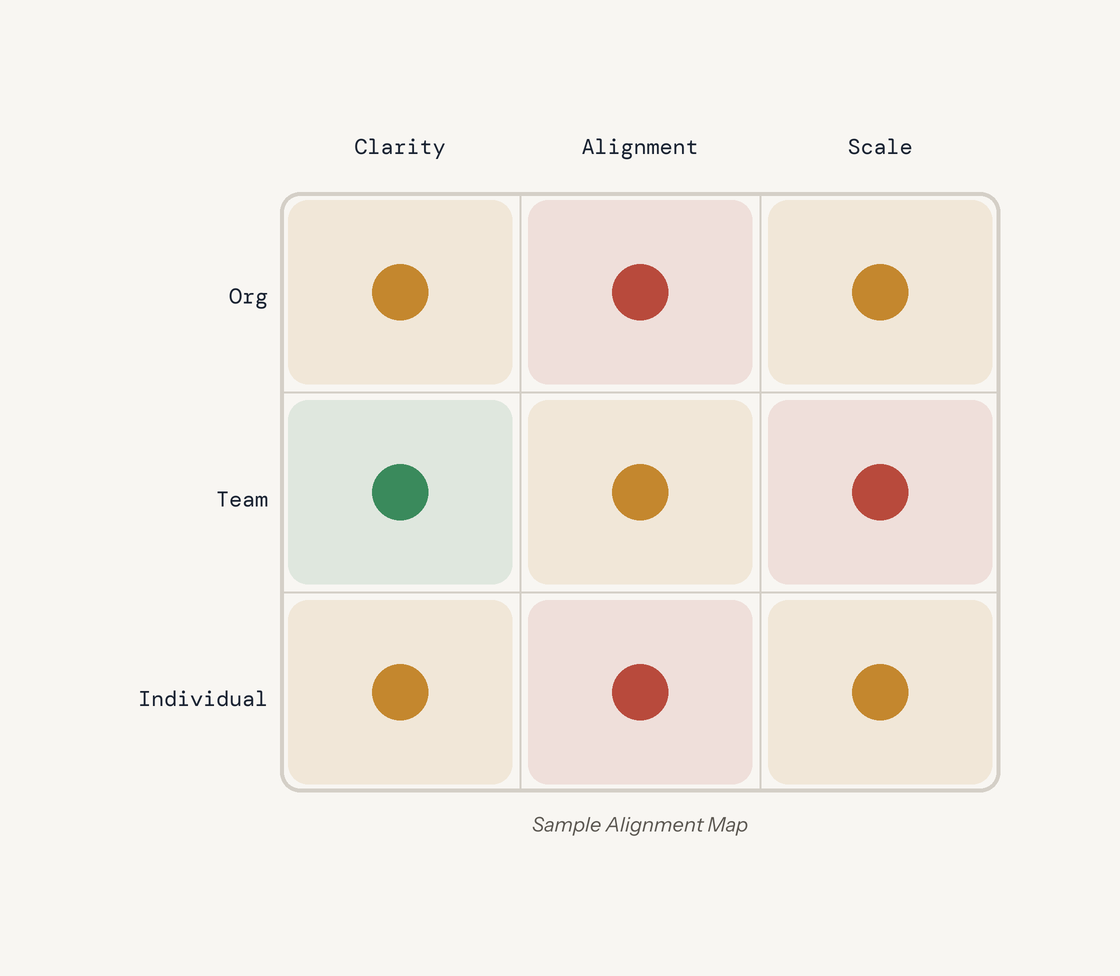
A clear picture of where your organisation is aligned and where friction is hiding, across three layers (organisation, team, individual) and three dimensions (clarity, alignment, and scale). Colour coded, so you can see at a glance what is strong, what needs attention, and what is broken.
Most leaders are surprised by what this surfaces. The problems you can feel but cannot name become visible and ready to act on.
- An AI Opportunity Brief
The three to five strongest opportunities in your business, ranked by impact and feasibility. For each one: what it is, what it costs you today in time or money, what you would gain, how hard it is to build, and whether your organisation is ready for it.
Grounded in your team's real workflows.
- One working agent, in production
Built and deployed on your highest value repeatable workflow during week two, alongside the people who will use it. Something your team is using when I leave, and can extend on their own.
- An ROI projection
A twelve month forecast across three buckets: time saved, money saved, money made. Costed, with the assumptions written down so you can argue with them.
- A Leadership Debrief
A ninety minute working session with your leadership team to walk through what we found, what it means, and what the first concrete step is.
How it runs
Before we start: a 30 minute scoping call to understand your business, your priorities, and which teams to include.
Week 1: your team completes a short survey. I review your existing strategy and process documents. I run 45 minute interviews with your leadership team and a selection of the people doing the work. By the end of the week we have picked the pilot workflow.
Week 2: I build and deploy the agent with your team, train them to extend it, build the ROI projection, and run the debrief.
Time from your side: roughly two to four hours of leadership time, plus fifteen minutes per survey respondent and 45 minutes per interviewee. Everything else is mine.
Which workflow we pick
Whichever function is holding you back most. I ask that directly in the scoping call, then test the answer against what discovery actually finds, because the two are often different.
Past pilots have landed in recruitment operations, marketing, and sales admin. What they had in common was high volume work with a clear quality bar, owned by someone who wanted the help.
Investment
From £12,000. That buys structured discovery in one function, one working agent in production, and the ROI projection.
Where several functions are in scope, discovery widens and the price moves with it.
If you go on to a full engagement within 30 days, half the Sprint fee comes off it.
Who this is for
Leaders of 20 to 100 person companies who know AI could help and are doing this without an engineering team. Operationally mature, ready to act on what we find.
The qualifying question: could your team get AI licences within two weeks of starting?
Who I am
I spent a decade in product leadership, including at Pivotal Labs and VMware, where the model was to pair with a team, teach as we went, and leave the capability behind. That is exactly how the Sprint runs.
The person in discovery is the person building, and the person training your team.
I run my own business on a team of AI agents I built, and I use it every day. The process I run with you is informed by doing it for myself first.
What makes this different: most consultants bring strategy, or they bring building. I do both, and I understand the human side of getting a team to change how they work. That third part is where most AI programmes die.
What happens afterwards
The Sprint stands on its own. You leave with a clear picture, a ranked list, a working agent, and a costed projection.
If you want to go further, the Installation is six months of building your AI Operating System across a priority function, with your team, leaving the capability behind. That is a separate conversation, and the Sprint gives you what you need to make the decision properly.
Next step
A 30 minute call to see whether this is the right fit. No pitch, no obligation.
Want to start smaller? Take the scorecard first. Two minutes, no pitch. You get your score and a clear next step based on where you are today.