
The AI Alignment Diagnostic
Two weeks to know what AI to build, what to fix first, and what to leave alone.
Most leaders know AI could help their business. The question is: where do you start, and how do you avoid wasting time and money on the wrong things?
The AI Alignment Diagnostic answers both questions in two weeks.
The problem with most AI advice
Most AI consultants start with the technology: "Here are 10 things you could automate." That sounds helpful, but it skips a critical question: are the workflows you're automating actually aligned with your strategy?
AI amplifies whatever you point it at. If your team is well-aligned and working on the right priorities, AI multiplies the impact. If there's confusion about ownership, unclear strategy, or processes that exist because "we've always done it this way," AI just scales the mess faster.
This diagnostic finds the opportunities AND checks the foundations. You leave knowing what to automate, what to fix first, and what to leave alone.
What you get
1. An Alignment Map
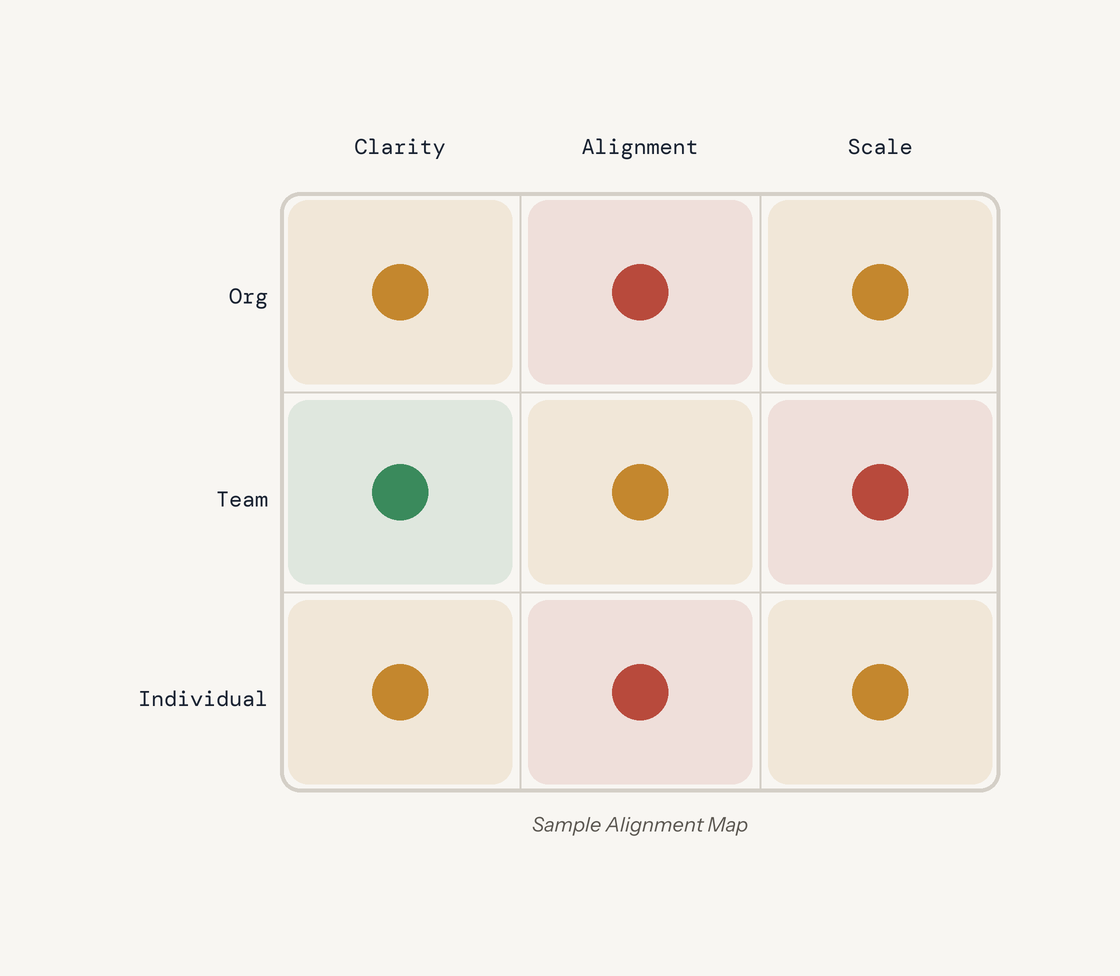
A clear, visual picture of where your organisation is aligned and where friction is hiding. Covers three layers (organisation, team, individual) across three dimensions (clarity, ways of working, and scalability). Colour-coded so you can see at a glance where things are strong, where they need attention, and where they're broken. Built on AlignmentOS, my diagnostic framework for 20-100 person companies.
Most leaders are surprised by what this surfaces. The issues you feel but can't name become visible and ready to act on.
2. An AI Opportunity Brief
The 3 to 5 strongest opportunities for AI in your business, ranked by impact and feasibility. For each opportunity: what it is, what it currently costs you (in time or money), what you'd gain, how complex it is to implement, and whether your organisation is ready for it.
Grounded in your team's actual workflows and your business priorities.
3. A Narrative Report
A short written document (3 to 5 pages) that ties it all together: what we found, where the biggest risks and opportunities sit, and a recommended sequence for what to do next. Written in plain language you can share with your team.
4. A Leadership Debrief Session
A 90-minute facilitated working session with your leadership team to walk through the findings, discuss what they mean, and agree on the first concrete step.
How it works
Before we start
A 30-minute scoping call with you to understand your business, priorities, and which teams to include.
Your team's time: 30 minutes (you).
Week 1
Your team completes a 15-minute survey. I review your existing strategy docs and processes. I run 45-minute in-depth interviews with your leadership team and a selection of key operators.
Your team's time: 15 minutes per person for the survey, plus 45 minutes each for interviewees.
Week 2
I analyse everything, build the Alignment Map and AI Opportunity Brief, write the narrative, and run the debrief session with your leadership team.
Your team's time: 90 minutes (leadership team, debrief).
Total time investment for your team: roughly 2 to 4 hours of leadership time, plus 15 minutes per survey respondent. Everything else is handled by me.
Investment
- £3,500 for a single-team diagnostic (6-8 participants).
- £5,000 for a cross-team diagnostic (10-15 participants across 2-3 teams).
Who this is for
Leaders running companies of 20 to 100 people who:
- Know AI could help their business but aren't sure where to start
- Don't have a technical team to figure it out
- Want a clear, practical plan they can act on
- Are ready to act on what they find
This is particularly relevant for professional services firms, agencies, training companies, property firms, and e-commerce businesses. Companies that are operationally mature but haven't yet applied AI systematically.
Who I am
I'm Liam Darmody. I'm a product leader who spent a decade enabling teams at Pivotal Labs and VMware. I now help leaders fix alignment first, then build a Personal OS for themselves and a Business OS for their company.
I built and run my own team of AI agents on Rundock, the platform I created. Named agents handle content, research, calendar management, and operations. I use them every day. The diagnostic process I run is informed by that hands-on experience.
What makes my approach different: I combine strategy (knowing what to build and what not to build), coaching (understanding the human side of adopting AI), and building (actually configuring AI systems alongside your team). Most consultants offer one of these. I bring all three.
The approach is the one I used at Pivotal Labs: pair with the team, teach as I go, leave the capability behind.
What happens after the diagnostic
The diagnostic is valuable on its own. You leave with a clear picture of your alignment, a ranked list of AI opportunities, and a concrete recommendation for where to start.
If you want to act on the findings, I offer an AI Team Enablement Programme: an 8-12 week engagement where I work alongside your team to build a Personal OS for you and a Business OS for your company. You get working systems and a team that knows how to run them.
But that's a separate conversation. The diagnostic gives you everything you need to make that decision with confidence.
Next steps
If this sounds relevant, let's have a 30-minute call to see if the diagnostic is the right fit. No pitch, no obligation. We'll talk about your business, your priorities, and whether this would be useful.
Not ready yet? Take the scorecard first. Two minutes, no pitch. You'll get your score and a clear next step based on where you are today.